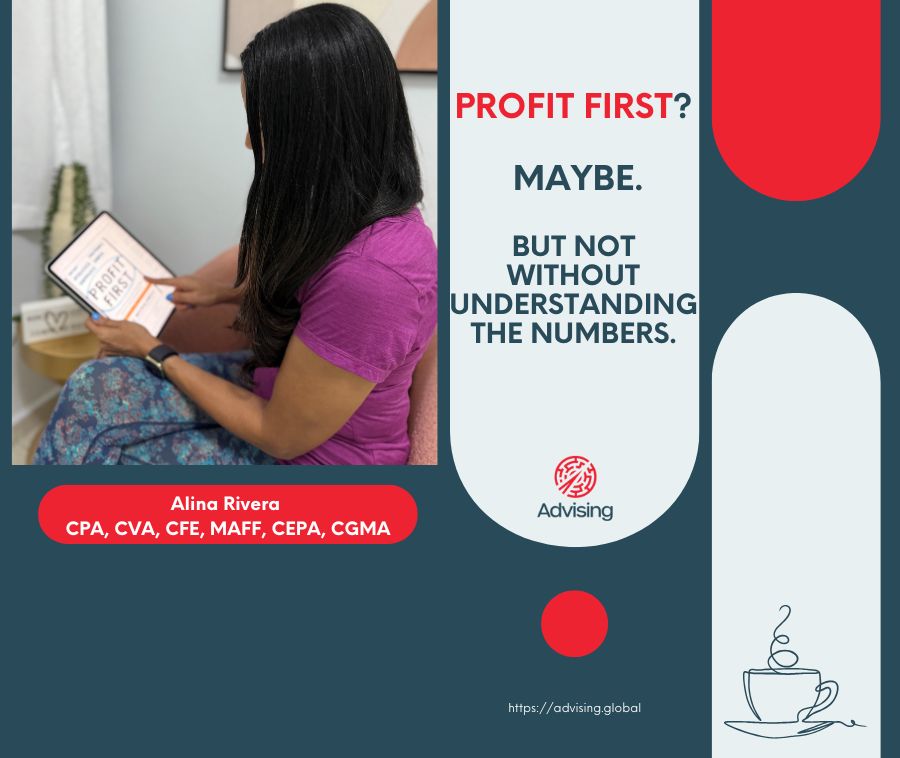
Blindly following trends can backfire. Let's unpack the nuance behind "profit-first" models.
The Problem Isn't the Framework. It's the Blind Application.
"Profit First" has become a rallying cry in the small business world. And on the surface, it's easy to see why. It offers a clear, behavior-based system for allocating cash, protecting profitability, and breaking the check-to-check cycle that so many business owners fall into.
But the problem is that a financial framework only works when it's grounded in financial reality.
I've reviewed businesses and received questions from business owners trying to implement Profit First without understanding their cost structure, margins, or cash flow patterns. The result? A false sense of control, misplaced confidence, and in some cases, serious liquidity issues.
Profit First isn't a substitute for financial analysis. It's a discipline tool. But discipline applied to the wrong numbers doesn't fix the problem.
Where It Works: Simplicity, Visibility, and Tax Preparedness
When applied with intention, Profit First can absolutely help stabilize a business. Especially for owners who've never set aside money for taxes or built any sort of reserve.
I've seen clients avoid major tax panic simply because they opened a separate bank account and moved 15–20% of every deposit into it, no matter what. That alone can change the game.
The habit of separating accounts makes things visible. You see what's available for operating, for taxes, for profit, and that visibility builds discipline.
If you've been running everything out of a single checking account and hoping for the best, Profit First can feel like a life raft. And in that sense, it's effective.
But like any tool, it only works if your business can sustain what you're assigning. If the numbers don't support it, the structure won't either.
Let's Call It What It Is: A System for Enforced Discipline
Underneath the catchy messaging, Profit First is a behavior-based system that uses structure to drive better financial habits.
It doesn't rely on complex spreadsheets or forecasting models. It works by dividing your income into buckets, profit, taxes, owner's pay, expenses, so every dollar has a job before it hits your hands.
That simplicity is part of its appeal. But it also means the system assumes the business model is already viable. If you're trying to enforce percentages on top of broken pricing or unstable revenue, you're solving the wrong problem.
And to be fair, most experienced Profit First implementers will tell you the same thing: the system works best after a company has stabilized its cash flow, reviewed its margins, and addressed any major financial blind spots.
Trying to implement Profit First in a business that's constantly short on cash or operating at a loss can do more harm than good. You don't treat the symptom before checking the vitals.
This is where many business owners get tripped up. Profit First helps you manage your cash. It doesn't help you make sure you have enough cash flow to manage.
You can divide your cash ten different ways, but if receivables are 45 days out and payroll is due in 10, you're still in trouble.
Profit First may guide how to allocate funds, but you need strong cash flow management to ensure the money's actually there when you need it.
Profit First Relies on Sound Margins. Many Businesses Don't Have Them.
The original system recommends percentage-based allocations for Profit, Owner's Pay, Taxes, and Operating Expenses. But here's what that assumes:
- Your pricing is accurate.
- Your margins are healthy.
- Your overhead is lean and aligned.
- Your revenue stream is predictable.
That's not the reality for most businesses under $5M. Especially those in the midst of scaling, dealing with seasonal or project-based cash cycles, or undercharging legacy clients because "they've been with us since the beginning".
It doesn't make any sense for you to move 10% to the profit account and then having to pay 5 to 6% interest on your line of credit because you didn't have the cash to pay your operating expenses. If your margins are weak or your cost of delivery keeps creeping up, "taking 10% for profit" isn't a plan, it's a liability. You're forcing a structure your business can't support and hoping the rest will catch up.
But business doesn't work that way. Frameworks don't fix broken models. They just organize them.
Allocating Without Cash Flow Discipline Is Risky
I've seen businesses proudly allocate funds to their Profit and Owner's Pay accounts every month, then quietly move the money back a few days later when cash gets tight.
What was the purpose, then? Stop fooling yourself.
If you're constantly reversing your allocations just to make payroll or cover expenses, your system isn't working. You don't have a profit-first business. You have a cash flow problem masked as discipline.
Profit First works only when it's built on operational stability, accurate forecasting, and clear financial visibility. Without that, it's just a ritual.
If your profit transfers come back faster than they go out, you're not building a healthier business, you're just rearranging the furniture while the house is on fire.
Creating multiple bank accounts and assigning percentages is helpful especially when you may lack control over how funds are used. But if you're skipping foundational questions like:
- Do we have pricing power in this market?
- Are we operating at capacity, or bleeding through inefficiency?
- Are we profitable by service line or just in aggregate?
The Real Work Comes Before the Percentages
Before you implement any allocation model, get honest about your numbers:
- What's your gross margin really?
- What's your average cost to fulfill a sale or service?
- How long is your cash conversion cycle?
- What's your monthly burn rate and runway?
If you don't know, you need to figure it out. If you do know and it doesn't support the allocations you want, that's your focus.
Adjust your model before you force percentages. Earn the right to call money "profit" by having a business that can actually retain it.
Cafecito Takeaway
Profit First can work for creating structure and reinforcing discipline. It's a great starting point for building habits, preparing for taxes, and finally paying yourself like a real business owner.
But it's not strategy. It's not a fix-all. And it definitely isn't cash flow management.
If your revenue is unstable, your pricing's outdated, or your margins are weak, the system will eventually show its cracks.
You can't hack your way to profit. You build it, with numbers that make sense, strategy that holds up, and a system that doesn't crumble the moment a payment comes in late.
Call it what you want, but if you have to pull money back every time things get tight, that's not profit. It's pretense.
Run your business with strategy, backed by real accounting, not shortcuts, not gimmicks. Profit First is a structure that supports strategy, but it is not a replacement for one.