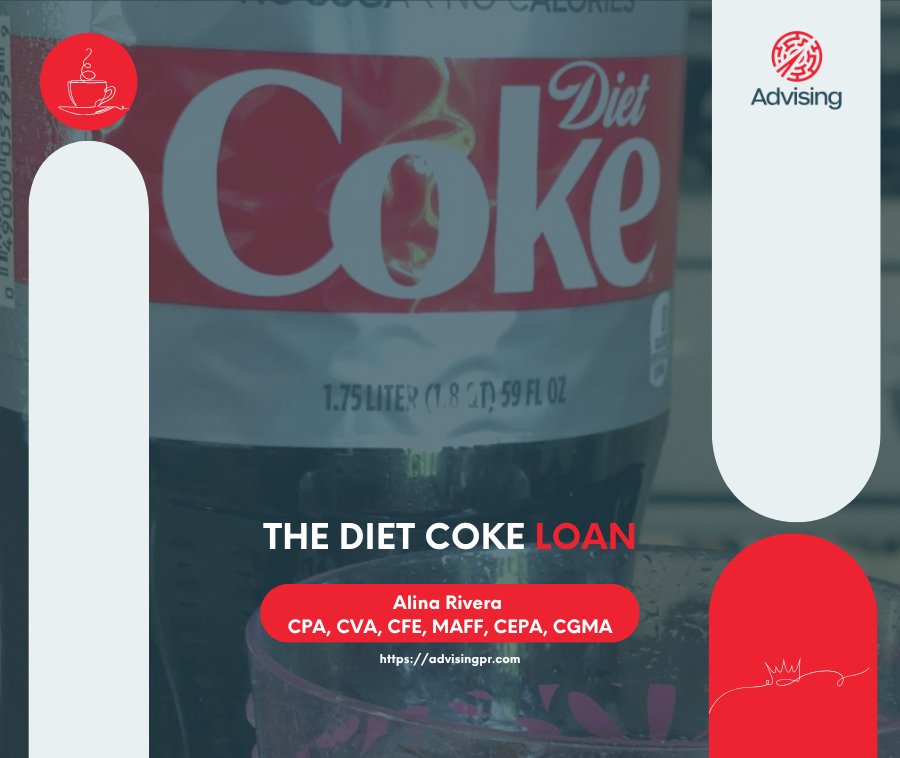
Apparently, cafecito is not my only vice. Diet Coke once a day is a close second.
And by “once a day”, I obviously mean whatever version of once a day allows me to say it with confidence while still having one cold can waiting for me like a tiny silver temptation in the refrigerator.
Yesterday, a client tried to convince me to stop drinking Diet Coke, and she did it in the most unfair way possible: she used a financial analogy. Her bachelor’s degree is in chemistry, so she understands ingredients, reactions, and what certain things do inside the body at a level I absolutely do not. I can analyze margins, cash flow, debt, value drivers, and why a business owner should be very careful before taking one of those fast-approved, high-interest loans. She can look at a Diet Coke and explain why my little afternoon happiness may not be the innocent treat I keep pretending it is.
So while we were talking, she basically told me, “Alina, drinking Diet Coke is like taking one of those big loans you tell people not to take. It solves the immediate issue, but later you pay for it somewhere else.”
I laughed because she knew exactly where to hit me. She was not trying to impress me with science I was going to ignore by the next meeting. She translated the issue into something I understand very well: urgent relief can be expensive.
The quick fix may feel like progress
Business owners usually do not take expensive money because they think it is a brilliant long-term strategy. They take it because something is pressing right now. Payroll is coming. A vendor is calling. A tax payment is due. A project needs funding. The business looks successful, but the cash is not where it needs to be.
That is why those financing offers can feel so tempting. The approval is fast, the process feels simple, and for a moment the pressure goes down. The owner can breathe again. The problem looks solved.
But fast relief can make the business ignore the real question: why did we need this money so urgently in the first place? Was it a timing issue, a pricing issue, a collections issue, an expense issue, or a business model issue? Because if the real problem is still alive underneath, the loan only buys time. A VERY VERY expensive time, by the way.
The business version of “I’ll deal with it later”
I see the same pattern in other decisions too. A business owner discounts too much because they want the sale. They keep a difficult client because cash feels tight. They hire someone quickly because they are exhausted. They ignore messy financial reports because opening them feels like opening a drawer full of things that should have been organized six months ago.
None of those decisions look catastrophic when they happen. Actually, most of them feel reasonable in the moment. That is what makes them dangerous. The business gets used to solving discomfort instead of solving the underlying issue.
Then a few months later, the owner is wondering why revenue is up but cash is still tight, why the team is bigger but the owner is still overwhelmed, or why the business is working harder but not producing more profit.
Why cash flow visibility changes the conversation
This is why I am always talking about cash flow visibility. Not because I want business owners to become obsessed with spreadsheets or spend their lives reviewing reports. Please, no. We have lives to live, trips to take, cafecito to drink, and in my case, apparently fewer Diet Cokes to consider.
Cash flow visibility gives the owner the ability to make decisions before everything becomes an emergency. It helps you see whether the business can afford the hire, whether a slow-paying client is creating pressure, whether expenses are growing faster than sales, or whether the pricing no longer makes sense for the way the business operates today.
A business with good financial visibility can still have hard seasons. Every business does. But the owner is not constantly being pushed into expensive decisions because they saw the problem too late.
The real cost is not always the interest rate
When I warn a client about high-interest financing, I am not only worried about the interest rate. I am also worried about what that payment does to the rest of the business. Debt service competes with payroll, taxes, inventory, owner’s pay, marketing, and growth investments. It reduces flexibility.
That is the part many owners underestimate. The payment does not live in a separate universe. It moves into the business and starts taking space every week or every month.
The same thing happens with other short-term decisions. The bad client takes space. The wrong hire takes space. The underpriced service takes space. The messy process takes space. Eventually, the business has no room left to breathe because too many “temporary” choices became part of the operating model.
Cafecito Takeaway
My client may or may not succeed in getting me to stop drinking Diet Coke. I am not making any public promises because I know myself, and I respect the power of a cold can in the middle of a long day.
But she made her point beautifully.
In business, the fastest solution is sometimes the most expensive one. Before taking the quick money, accepting the bad client, discounting the service, or postponing the uncomfortable decision again, pause long enough to ask what problem you are really solving.
Because a healthy business is built by creating enough structure, margin, and financial visibility so every issue does not become a crisis with interest attached.